Every family has a beginning. This one begins in fire.
Available in hardcover, paperback, on Kindle, and now as an unabridged audiobook.

The Kindle edition features reflowable text, allowing readers to adjust the font size, typeface, spacing, and screen display for a more comfortable reading experience.

Experience The Night the Bells Burned in an unabridged performance narrated by Ernest W. Pierce. Thirteen hours and 45 minutes of history, danger, faith, and one family’s fight for freedom.

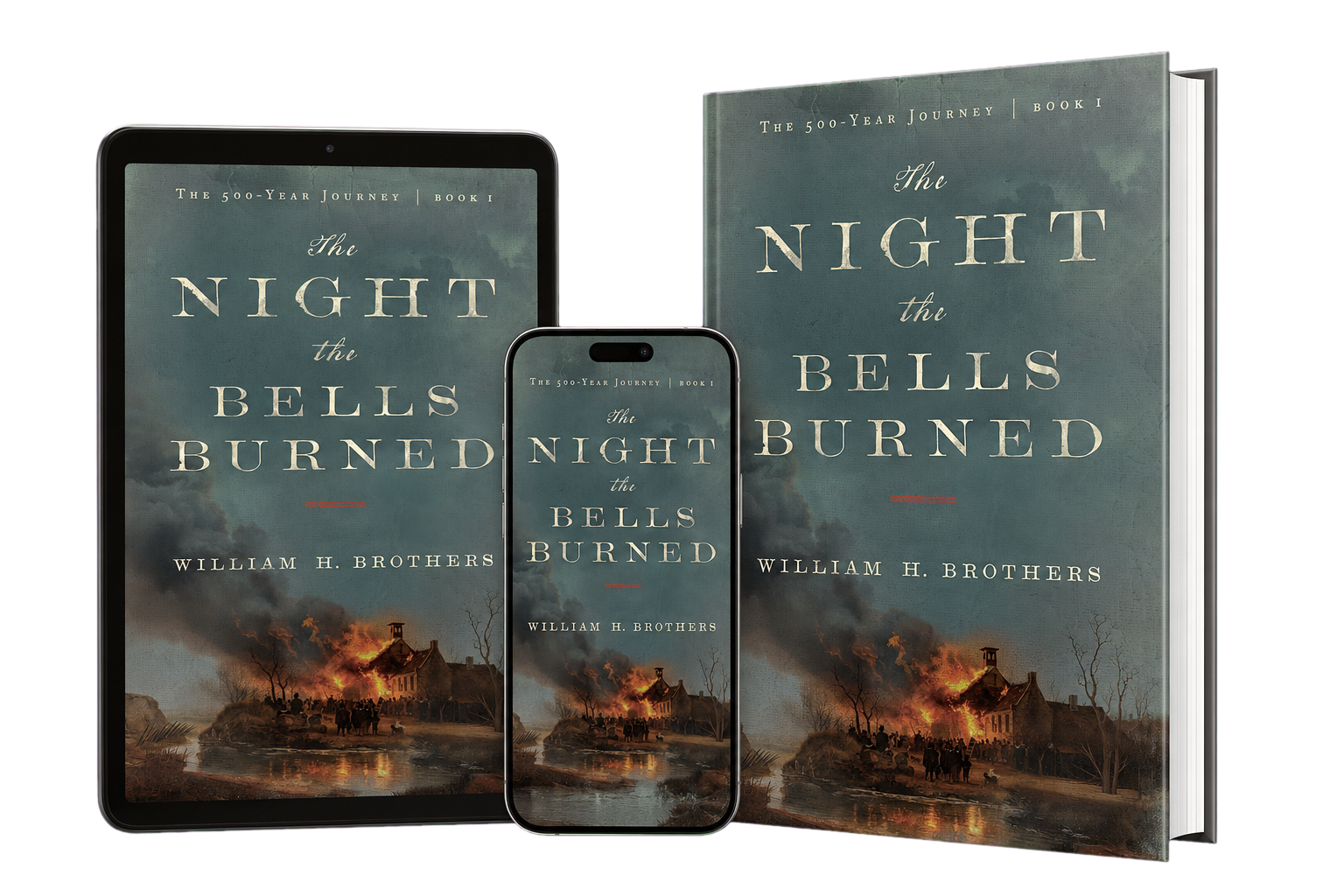
The Night the Bells Burned
Book I in The 500-Year Journey Series
In 1544, in the Spanish Netherlands, Cornelis Schutt gives his wife a vow he cannot take back: their children will grow up free.
He does not yet know that freedom can make a family visible.
The Spanish Empire is tightening its grip. Faith is watched. Doors close when soldiers pass. Neighbors lower their voices. A baker burns in the square. Families are hanged for the wrong book. A careless prayer, a hidden page, or one act of mercy can turn an ordinary household into a target.
Cornelis believes caution will protect them. He believes hard work, obedience, and silence can keep danger outside his door.
But silence has a cost.
When fire and fear reach the streets, Cornelis must choose between safety and conscience, obedience and faith, the life he can preserve and the promise he made to the woman he loves. Beside him, his wife measures what every choice may cost their children: bread, shelter, names, and the chance to live without fear.
Rich in historical atmosphere, family danger, and emotional stakes, The Night the Bells Burned is a gripping historical thriller about one family caught in the machinery of empire — and the vow that will outlive fire, exile, and time.
This is where The 500-Year Journey begins.
Excerpt…
Hendrickus stepped to the long table beneath the lean-to. “Here.”
They gathered. On the table lay a rough map of the island, a coil of tarred cord, a bucket of lead balls, and a single sharpened spike. Hendrickus placed a wooden gate peg beside the map.
“They will not bring deep ships,” Hendrickus said, tracing the Vlieter Channel with one finger. “They come shallow. Shallow barges and skiffs. Oars wrapped. Lanterns low.”
“They want the forge,” Pieter said.
Maarten finished it. “They want to teach the islands to kneel.”
Hendrickus faced them. “We are not holding Wieringen. They will burn it. We are breaking them long enough to live. That is all. At the weirs, we set three lanterns. Decoys. Set far enough apart to draw them dead center.”
“If they swing wide?” Pieter asked.
“They will not,” Hendrickus said. “Don Diego will take the straight line to the bell. He will believe he is smarter than fishermen.”
He lifted the wooden gate peg. “Tide peaks. Horn. Then the pin.” He set it down with a definitive thud. “The gate swings. Water forces them sideways into the weir mouths. They jam. And before they can panic, we snare them. Belly nets sunk between the eel fences. Lines stretched low. Oars snag. Ankles tangle. Men in corselets do not swim.”
“They will cut free,” Pieter argued.
“They will try. In the dark. With wet hands. Every second they cut is a second we live. No Spaniard leaves Wieringen alive.”
The words settled like ash. Pastoor Paulus approached from the church path, tar staining his hands. “The bell,” he said.
“You and the boy from the church yard,” Hendrickus commanded.
Paulus hesitated. “He is only sixteen.”
“Sixteen pulls rope,” Pieter said. Then, quieter: “Sixteen dies.”
Adriana turned on him, her face tight, but Pieter did not look away. “I am naming it,” he said.
Hendrickus raised his hand to quiet them. “No speeches. Three barges in. Tide peaks. Horn. Pin. Nets. Guns. We plan as if we are already burning.”
Assignments followed. Pieter and Maarten to the marsh. Elsa to the porch. Adriana to the children. Paulus to the tower. They began to move, the yard emptying until only Elsa lingered.
“You said we are not holding Wieringen,” she said quietly.
“No.”
“What are we holding?”
Hendrickus thought of his son, Wilhelm. He thought of the future moving south while war moved north. “Each other,” he said.
Behind them, unseen, Annalies stood in the doorway with a cup in her hands and the plan in her ears. She imagined Don Diego stepping onto the strand. The shine of his boots. The way he measured people like property. Would he remember her, or only that she had obeyed so well?
She felt his thrill before he even stepped ashore. The wind shifted across the marsh. The tide would turn whether men were ready or not.
When it did, she prayed no Spaniard would leave the island alive.