The fire has passed. The debt is coming.
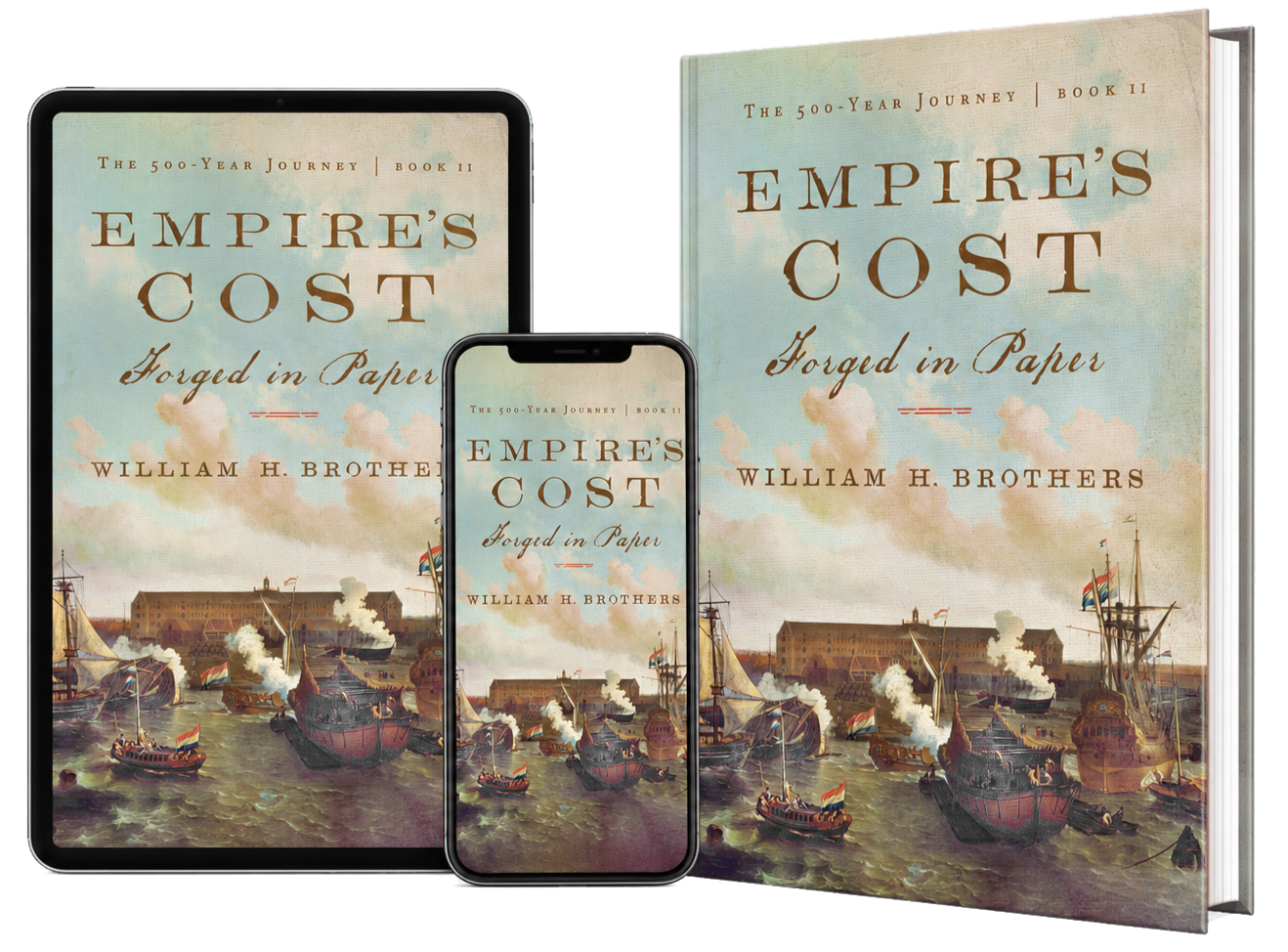
Available in hardcover, paperback, and on Kindle.

The Kindle edition features reflowable text, allowing readers to adjust the font size, typeface, spacing, and screen display for a more comfortable reading experience.

An unabridged audiobook edition is coming soon to Audible.
Empire’s Cost: Forged in Paper
Book II in The 500-Year Journey Series
Amsterdam, 1595.
The Schutt family survived the fires of empire.
Now empire has found colder weapons.
Jansen Schutt is raised at the anvil, where one flawed strike can kill men he will never meet. His family’s iron moves from forge to dock, from countinghouse to convoy, from the hands of craftsmen into the machinery of war and trade. Each order feeds his household. Each shipment may carry someone else’s ruin.
Amsterdam is rising. Ships crowd the harbor. Merchants speak of spices, silver, tulips, and distant seas. Paper promises can build fortunes overnight — or ruin a family before morning. Behind every contract stands a household: a wife counting what remains, a child inheriting what cannot be paid, and a name that may cost more to keep than to lose.
Jansen wants to believe skill and honesty can protect those he loves. He wants to believe a good man can prosper without becoming useful to cruelty.
But empire does not only burn villages.
It counts. It lends. It signs. It collects.
As Amsterdam learns to turn risk into wealth, Jansen must choose between prosperity and conscience, ambition and family, the future he can buy and the debt his children may inherit.
Rich in atmosphere, moral danger, and historical sweep, Empire’s Cost: Forged in Paper is a gripping historical thriller about money, power, family, and the price of building an empire.
The fire has passed.
The debt is coming.
Excerpt…
Before breakfast, before the broth, before the bank could come to the door, Jansen struck where his father told him not to. The blow landed wrong. Jansen knew it before the shock ran up the haft, through his wrist, and into his teeth. He jerked back.
Wilhelm Schutt kept his eyes on the iron in the tongs, watching the heat and the timing both. “Now look at it,” he said.
Jansen bent over the anvil. Sweat ran off his brow and stung his eyes. Along the base of the horn, a fine crack had opened in the iron. His stomach dropped.
“God in heaven,” he whispered.
“You heard me,” Wilhelm said. “Before breakfast is when a bad anvil is still a bad anvil.”
“It was one blow,” Jansen argued.
“It was one foolish blow.” Wilhelm set the iron back in the coals. “If he misses again, men bleed for it.”
Jansen’s mother, Anna, looked up from the table, scraping a cheese rind into a morning pot—trying to find one more meal in the week. “And if you break the boy before noon, what do you suppose I feed him with?” she asked.
Wilhelm looked at Jansen then. Not kindly. Not cruelly. “Prince Maurice’s quartermasters want seventy wedges by dark. If they are not on the dock, the order goes elsewhere. If the order goes elsewhere, the bank comes to the door. You are old enough to know it too.”
Across the rooftops, the Oude Kerk struck the hour. One bronze note. Jansen froze. The sound caught him in the chest so fast it was like a hand closing there.
For an instant, the forge was gone. He was six again, barefoot in summer dirt while bells tore across the city and men shouted that the Prince was dead—shot down by Spain in his own house.
“Jansen.” His mother’s voice pulled him back.
Wilhelm saw the lapse. “You still do that,” he said. “You leave.” He reached for the spoiled wedge with the tongs. “If your mind wanders, the flaw goes with the iron. Then the gun fires in Flanders. The carriage kicks. The wedge slips. Some gun crew learns your mistake with blood in its mouth.”
He held up the piece. “There. Look at it.” Jansen saw the slight swelling where the metal had turned under hesitation.
“We do not stand in the pike line,” Wilhelm said. “But we are in the war all the same.”
A dock runner appeared in the doorway, winded, wearing the orange favor of the Count of Nassau. “Order from the Lastage,” he panted. “The convoy moves at first light. Not seventy wedges. Ninety. And not a stiver of payment unless the complete order is on the dock before vespers.”
Anna did not stop pulling the bellows. “How much coal do we have left?” she asked.
Wilhelm looked at Jansen. “Choose your age,” he said.
Jansen set the order on the bench and stepped back to the anvil’s sound side. The crack had not changed. The order had.
“Tell the quartermaster the wedges will be there,” Jansen said. Then he brought the hammer down.